

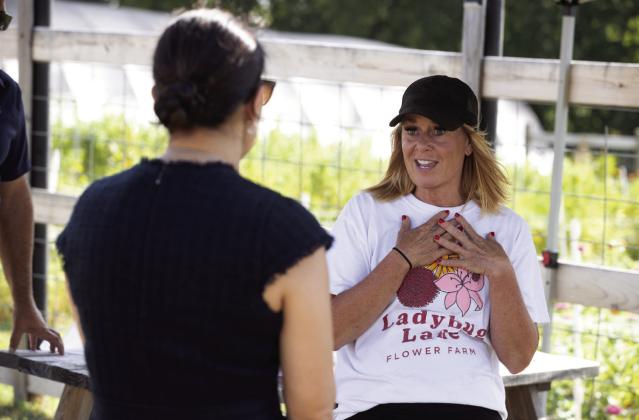
Jennifer Husmann, owner of Ladybug Lane Flower Farm, speaks with U.S. Rep. Stephanie Bice, during a tour of the flower farm near Guthrie. Bice visited to learn about Oklahoma’s growing flower-farming and agritourism industry. Photo by Brent Fuchs.
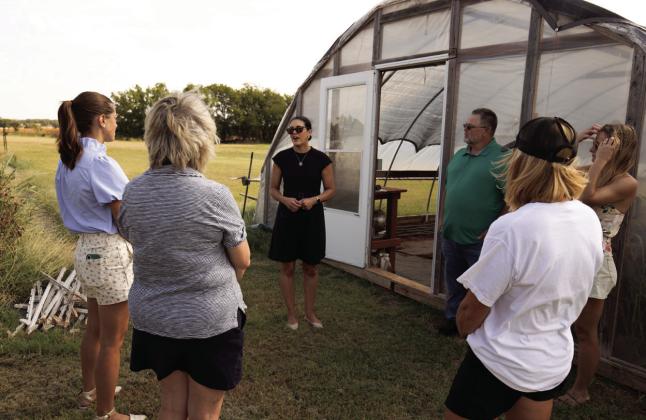
U.S. Rep. Stephanie Bice speaks to Oklahoma flower farm owners about the struggles they face. The farmers talked with Bice about state tax policy and getting the floriculture industry recognized alongside traditional agriculture. Photo by Brent Fuchs.
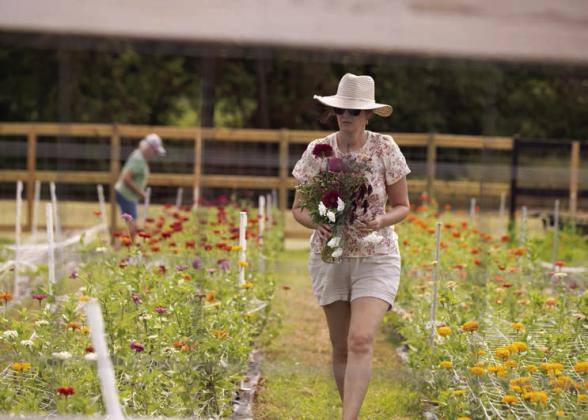
A customer picks fresh flowers during a u-pick event at Ladybug Lane Flower Farm in Guthrie. Photo by Brent Fuchs.
Oklahoma Flower Farmers Cultivate a Growing Market
What began as a new adventure on a family homestead has grown into a thriving flower farm, and a glimpse into an agricultural industry gaining roots across Oklahoma.
U.S. Rep. Stephanie Bice recently visited Ladybug Lane Flower Farm in Guthrie to meet with flower farmers from across central Oklahoma, learn more about the state’s growing agritourism industry and hear about the challenges facing floriculture producers.
“The agritourism business across Oklahoma has been really growing, and one of the hidden gems is flower farms,” Bice said. “There are so many flower farms. I learned today there are 250 flower farms across Oklahoma. I came here today to hear from farmers across central Oklahoma and learn a little bit about their business.”
Other local flower farms joined Ladybug Lane for the visit, giving Bice an opportunity to hear from producers with a variety of business models. Some farms sell wholesale flowers, while others offer subscriptions, photography opportunities or allow customers to pick their own flowers.
For Ladybug Lane owner Jennifer Husmann, the visit was an opportunity to showcase an industry she believes deserves to be recognized alongside more traditional forms of agriculture.
Husmann spent nearly 20 years in corporate technology sales and four years in politics before mov- FL WER FARMS
gathered in Guthrie to showcase a growing industry.
Eden Flower Farm & Greenhouse Edmond
Cottage Flowers OKC Oklahoma City Frankie’s Farm Guthrie
Sunsets & Blooms Tyrone
Ladybug Lane Flower Farm Guthrie ing to Guthrie and building upon her husband’s family homestead.
The property had been a successful cattle ranch since the 1950s, while also producing other crops on a smaller scale. Husmann had always been an avid gardener, and her mother had spent years teaching her about flowers.
Moving to the farm gave Husmann the opportunity to try something she had never done before.
“Starting something I had never done before was scary and exciting,” Husmann said.
Before planting her first seed, Husmann wanted to know there would be a market for what she planned to grow. She began selling flower subscriptions in the community before the first seeds went into the ground.
Her strategy worked. Ladybug Lane’s first three seasons focused on community-supported agriculture subscriptions, commonly known as CSAs. In its fourth season, the farm added u-pick opportunities. By the fifth and sixth seasons, the farm had expanded to include wholesale operations.
Now in its sixth season, Ladybug Lane has reached another milestone. Husmann and Bear Creek Farms in Stillwater have collaborated to provide locally grown fresh flowers to Whole Foods stores throughout Oklahoma.
Jennifer won’t say so herself, but that’s kind of a big deal.
The growth of Ladybug Lane reflects a broader trend among Oklahoma flower farmers, many of whom are working together to strengthen the market for locally grown flowers and other Oklahoma products.
“Today, I was hoping we could bring together a variety of flower farmers from around her [Bice’s] district and show her just how much this industry is growing,” Husmann said. “We’re working to build a stronger presence in the market for local flowers, local produce and Oklahoma-grown products.”
One of the biggest challenges facing flower farmers is that, despite being agricultural producers, they do not always receive the same benefits as other farmers.
Husmann said flower farmers currently do not receive the same agricultural tax benefits when purchasing items such as fertilizer, sand and soil.
“Although flowers are considered agriculture and monitored by the USDA, we are not considered a consumable to get that tax benefit,” Husmann said. “So what we’re really trying to do is just make sure we get the same agricultural benefits that other farmers do.”
Bice agreed that recognition is an important first step.
“The owners of these farms talked about how they maybe get overlooked because they’re not a cattle farm or some sort of traditional ag,” Bice said.
“Having them recognized as a farming community that is providing a service and/or product to consumers is important,” Bice said.
The growing industry has not been without challenges. Drought and extreme heat have made it difficult for local growers, with flowers struggling to recover between stretches of intense temperatures.
Ladybug Lane is conserving water while protecting its crops and has temporarily closed its u-pick operation until temperatures fall below 100 degrees.
“Once the temps drop below 100, we will reopen for u-picks,” Husmann said. “I’ve got to make sure my people are safe and the flowers remain healthy.”
Despite the challenges, Husmann said the farm’s growth is proof there is a place for flower farming in Oklahoma agriculture.
For Bice, the visit provided a firsthand look at an industry continuing to take root across the state.
“It was a great opportunity to see how the industry has grown across Oklahoma and, more specifically, in my district,” Bice said.