

Bugler’s blast lost in wild cheers as homesteaders raced for the promised land
At noon on April 22, 1889, a lieutenant stood at the north line of Oklahoma, watch in hand, while guards held ropes marking the line.
He turned to the bugler and signaled. The bugler blew a blast, but the end of the blast was lost in the wild cheers and yelling that went up, and the line melted as those thousands waiting urged their horses into full speed in unison.
Some of them left their wagons, families and supplies behind to follow, for many a man had paid high prices for an extra horse, a fast one, sometimes paying as much as $550 for a horse that may be a little faster than another, to make the wild dash for a homestead.
Others unable to hand out the money had to resort to taking their chance with a team, wagon, family, and all, falling behind those who, with their unencumbered speed, could dash on to the best farmlands.
On they flew, first in a bunch, then separating as they gained speed and spread out in different directions. Many kept in a bee-line for Guthrie.
Others headed for the southeast, and fewer for the southwest. Within three minutes some of the fleetest were three miles to the south and still going at full speed.
The wagon train moved slowly southward, and by 3 p.m., many had crossed the Cimarron. Others had reached their claims and stood as the proud owners, most for the first time in their lives, of 160 acres of the best farmland on the North American continent. The rich valley of the Cimarron was soon covered with men, the more fortunate ones.
South of Alfred, men were urging their horses to their capacity of speed. Those who were forced to rely upon horses taken from a farm team had quickly fallen behind.
Gleefully, some of the winners waved to a neighbor. Others dropped to the ground and began to spade shovels full of the rich soil. Others began immediately to improvise a shelter.
Others just stood there, reveling in the possession of good farmland for the first time.
Those members of the family following in the caravan of covered wagons appeared not to be in great haste. Some of them would find a nice spot and camp for the night, knowing that their early arrival at the chosen spot was not pressing. They could continue tomorrow and find their husbands and fathers sitting on a nice claim. Campfires could be seen rising in all directions long before nightfall.
However, there were many who did not play the game straight. Seeking an unfair advantage, some had sneaked across the line and concealed themselves in bushes and in the tall grass, waited until they heard the blast of the bugle, then sped ahead, or simply staked their claim where they were. Some of the legal home seekers reported that as they neared the spot they had selected, the site simply came alive with men. Sometimes the newcomer chose to contest the site, but others rushed on for another choice, choosing not to enter controversy.
The train headed for Guthrie crept slowly along, keeping even with the fastest riders on horseback. The first train pulled into Guthrie at 1:20 p.m. It was densely packed and crowded, and the passengers seemed to roll in a wave as they began to crowd toward the platforms, from the domes of the baggage cars, and off the tops of the cars.
Baggage, tents and supplies were tossed from the windows before the train had stopped, the passengers hoping to recover them as they ran, or to return after they had staked their claim. They ran up the hill, past the land office and the lots already staked, until they found an unstaked, untended lot.
It seemed that almost every man had in his hand a hatchet or an ax, four pegs with which to mark the boundaries of their newly claimed property. A few had ropes for the same purpose. Halfway up the hill stood the land office, an unpainted frame building 16 by 20 feet. It was the only structure other than the railroad station and the homes of the railroad section crews.
The first hotel was quickly erected near the railroad station, known for a short time as the Santa Fe house. It consisted of 50 tents, five large ones being designated for dining rooms, and an estimated 200 beds. It had been set up by General J. N. Reece, Colonel Jake Wheeler, and Colonel J. C. Bell, all of Springfield, Illinois.
On the hill south of the land office had been erected a wall tent, a sign at the entrance identifying the temporary shelter as the post office.
Just north was another tent, above it a flag waving, marking the location of the headquarters of United States marshal, a busy man for the occasion.
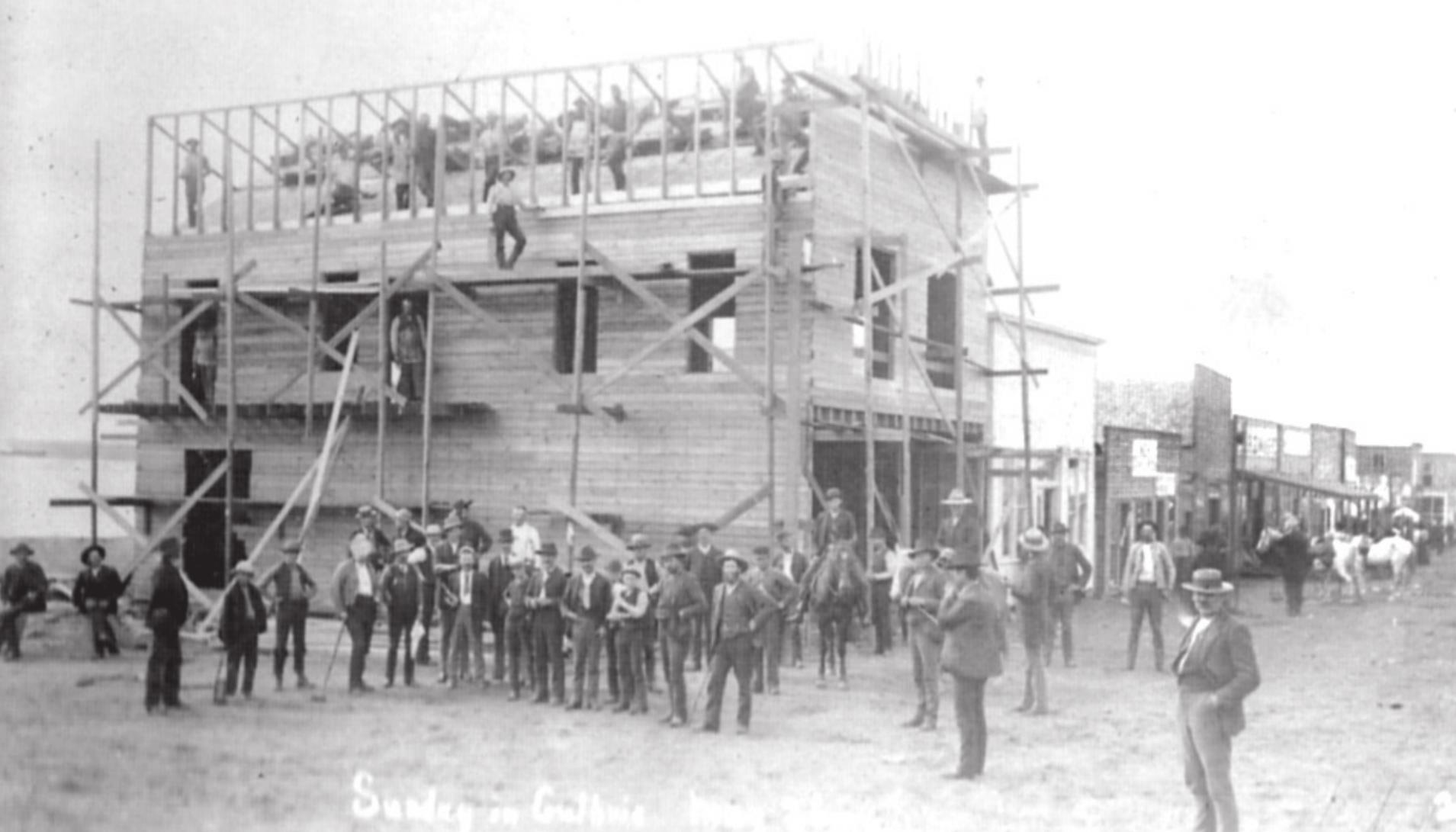
By nightfall, a green and rolling prairie was a city of tents, stretching five miles east and west and two miles north and south. An open space inhabited by a few men working for the railroad and in the land office had in a few short hours become a city of at least 10,000.
“I’ve not had a bite to eat or a drop of water to drink,” said one man as he paced back and forth on the lot he had claimed.
“Say mister, can we take up a lot, one for the husband and one for the wife,” inquired a woman who stood astride a rope that marked the boundary of two town lots.
Messages were scribbled on shingles or pieces of cloth and posted on many of the lots whose new owners were forced to leave them, the messages proclaiming that the spaces were already claimed.
The Santa Fe Railroad was praised for its efficiency in handling its immense crowd. Superintendent Turner said that the first train into Guthrie brought about 1,000 passengers, and there were nine others to follow, each with approximately the same number, making a total of 10,000 home seekers brought to Guthrie on the first day.
Besides the matter of finding, staking and holding one’s lot, the next biggest problems were food and water. In the excitement and anticipation, few had bothered at the time of preparations to provide themselves with either food or drink. Many would have to wait for food when it could be brought in.
The Santa Fe had drilled a well for its workers, and many of the new citizens made what could easily be called a run on the railroad’s well, but the company, fearing that the well would be soon depleted, placed guards on the well to prevent its being robbed.
Some of the more enterprising saw the opportunity and delivered to the lot holders at five cents a glass the water from the Cottonwood. What had been described as a ‘crystal clear’ stream in the advance material, had become a muddy stream from recent rains, but the condition of the water seemed to matter not at all. It quenched the thirst.
The first meeting in the new territory was called to order at 11 a.m., April 22, while those who had chosen to abide by the rules were still being held at the line waiting for the bugle to sound. That meeting followed the selection of lots by a group from Topeka, Kansas, a group which came to be known as the Topeka Crowd. Choice lots had been found by those who had hidden in the area the night before and came forward in the morning.
General H.A. Pierce of Topeka presided, with John M. Rankin as secretary, and the principal activities were to band together for mutual protection.
There were many men on hand who were quite ready to identify themselves as deputy U.S. marshals, but they were also ready to drive a stake into the ground to make a claim as soon as they gained access to a choice lot. These men were often a threat to those who had “made the run” early.
An example of the stories making the rounds was one that a man on horseback arrived at 12:15 with the story that he had ridden from the line on the east, and this claim led to the comment that he had done some fast riding to make the distance in that time.
From Caldwell to the west, came the report that on that first day 2,000 wagons and several hundred horsemen were drawn up in line two miles north of the Oklahoma line.
At 10 a.m. Captain Woodson, who said that it appeared all had arrived, gave the command to move toward the starting line, and by 11:30 a.m. they had all arrived at the line, ready for the free-for-all race. Captain Woodson addressed the group in the name of the United States government, thanking them for their orderly conduct and complimenting them on the law abiding activities.
At 12:03 the bugle sounded on the western starting line, and the boomers were off. A few yards from the starting point a boomer’s horse stumbled and fell on its rider, breaking the man’s neck. Another boomer wishing to encourage the horse drawing his buggy to more speed fired his shotgun into the air and accidentally killed a neighbor boomer. N.P. Reece, a photographer, reported that the night before the run, the boomers held church services, and during the sermon two men became engaged in an argument regarding a horse swap, and one of the men was fatally stabbed.
Alt Text for Image