

“If you open a shop or bring in a peddler’s wagon, you’re going to have to pay for it.”
That was one of the first resolutions passed by the first Guthrie city council at its initial meeting on April 26, 1889.
A few days after that first meeting, which was held in the tent used as a city hall, the city council reported that revenue had to be provided for city government operations. “Occupation taxes” were imposed, ranging from $10 to $12 a year for a blacksmith shop or peanut vendor to $100 a day for a circus.
Lumber yards paid $20 a month in Guthrie Proper, where 22 businesses were in operation and 16 others in East Guthrie paid $10 a month.
Book agents were taxed $40 a year. If a merchant peddled his goods from a wagon, he paid a yearly tax of $200. Billiard parlors were assessed $40 for each table, while livery stables paid $40 and $1 additional for each rig. Lawyers paid only $20, but bankers and fire insurance agents were assessed $100 each.
All occupations were covered except for the ministers. Those merchants unable to produce a tax receipt were subject to arrest and payment of a fine.
Several lawyers who refused to pay threatened to appeal to the U.S. courts and were promptly barred from practice in justice, police, and appellate courts here.
During May, June and July of 1889, a study of tax ordinances put into effect at that time shows that methods adopted to secure prompt payment of taxes levied on city lots were as drastic as those used in handling occupation taxes.
Next was East Guthrie on June 1 when a tax was levied on every lot in the town site. Taxes ranged from 50 cents to $7.50 and parties found on the lots by the tax collector were given five days to pay. Where no occupant was found, a notice was posted demanding payment within five days under penalty of forfeiture of the lot to the first person appearing and paying the tax. There were still homesteaders waiting in the wings for a good lot. There was no period for redemption, and no waiving of penalties. An owner either paid promptly or lost his lot.
When in October and November of 1889 special school taxes were levied to support the first public schools, provision was made for the sale of all lots upon which taxes were not paid within 30 days, the proceeds to go to the school fund.
Each of the then four cities of Guthrie had separate governments, with mayors, councilmen and school boards. The governments of East Guthrie, West Guthrie, Guthrie Proper and Capitol Hill were uniform in ordinances adopted, but there were various methods of enforcement.
In each city, the most serious misdemeanor was lot jumping and was punishable by fines ranging from $25 to $100 for each offense. The unlucky person who could not pay his fine promptly had to work out his penalty on the streets or other public works at $1 a day.
In East Guthrie, destroying or damaging a tree or shrub drew a $50 fine. The same offense in Guthrie Proper drew a fine from $5 to $10. In West Guthrie, it was overlooked entirely. It cost $20 to $25 to use foul language or talk loudly on the streets of East Guthrie and from $5 to $10 in Guthrie Proper.
Fines for gambling, prostitution and discharging firearms were $2 to $10 in all four cities.
Some of the ordinances passed and adopted went to great length to “protect public morality, decency and good order.”
Early ordinances prohibited intoxication, gambling, keeping gambling houses and devices, indecent exposure of person, impersonating opposite sex, keeping houses of ill-fame, and associating with prostitutes. When East Guthrie city fathers made a canvas of that area, they were dismayed at the number of houses of ill repute and quickly provided regulations for both the houses and their shady ladies.
An operator of a bawdyhouse was subject to a $50 fine and the inhabitants of such a dwelling were liable for a $20 penalty for each offense.
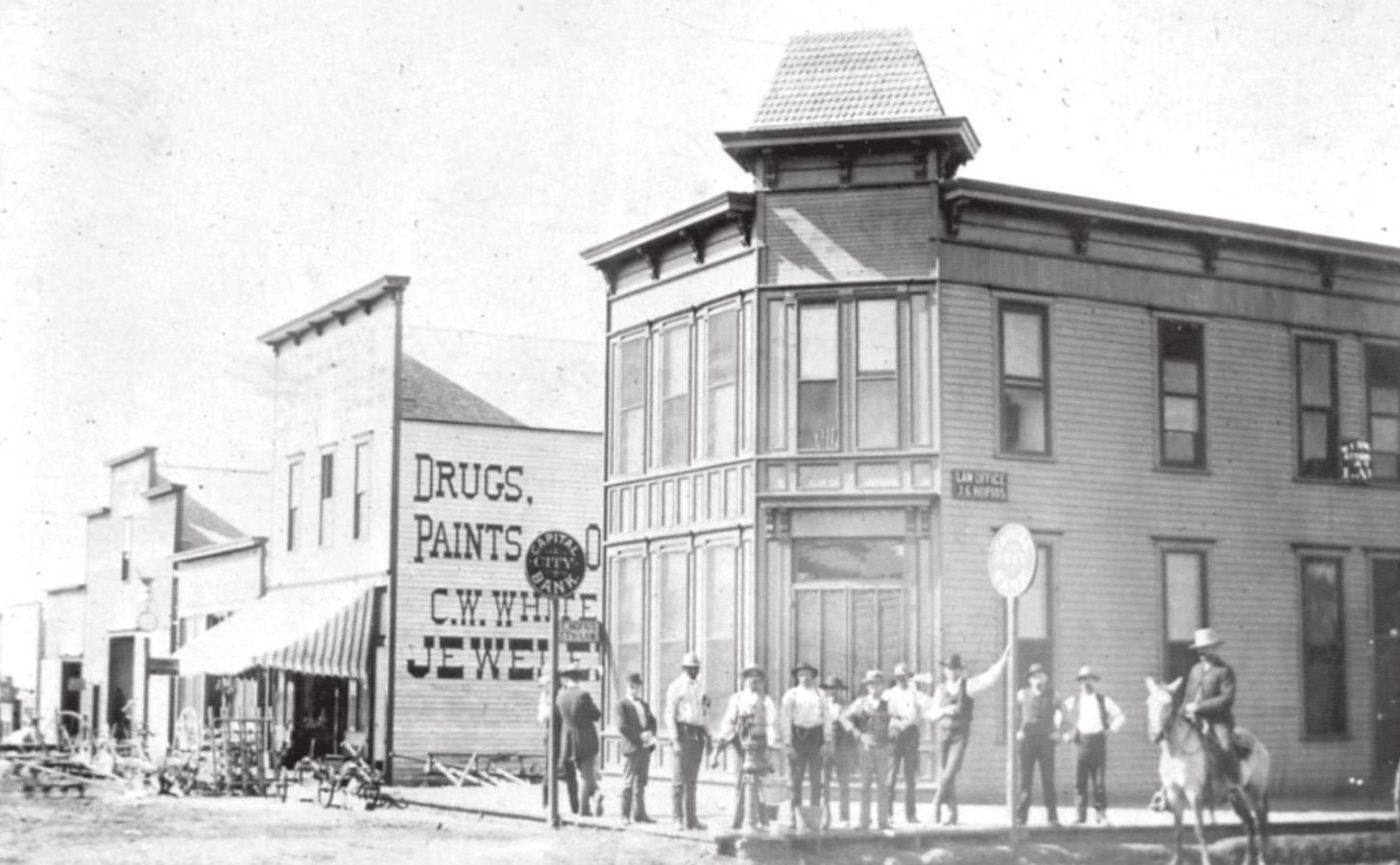
On the first day of the Run, settlers occupied 1,200 acres of the area where Guthrie now stands. This necessitated four different city councils and mayors to be elected. All four cities, Guthrie Proper, East Guthrie, West Guthrie and Capitol Hill, extended north to the present location of College Street and south to the present city limits. Guthrie Proper included the territory between Division and Seventh Street west; East Guthrie extended east from Division to Walnut Street, Capitol Hill began at Walnut Street and extended to Pine Street, and West Guthrie ran from Seventh Street to 14th Street.
Each city council enacted its own set of laws and it became increasingly confusing for a citizen who tied his horse on the street in West Guthrie and find that when he journeyed across Division to east Guthrie he would be fined if he hitched his horse where it would graze on another man’s land.
One of the early acts of the Guthrie Proper council ordered that draymen and delivery wagons passing through the central city, which proudly controlled the Santa Fe Railroad, should pay a fee for every trip.
East Guthrie sought to solve this problem by its first executive act, that of sending the mayor as a delegate to St. Louis in an effort to entice the Frisco Railroad through East Guthrie.
In Guthrie Proper, it was a misdemeanor for a woman to appear on the street dressed in men’s clothing or “in any other unusual or sensational attire.” In West Guthrie if a woman dressed in her husband’s clothes and rode a horse to the West Side Market, it was not looked upon as improper.
After about a year of friction occasionally between the cities over the conflicting laws and ordinances, the joint councils of Guthrie, East Guthrie, West Guthrie and Capitol Hill met to resolve their differences.
On June 20, 1890, an ordinance entitled, “An ordinance providing for the consolidation of the four cities” was introduced and adopted by unanimous vote. After several meetings of the “Consolidated Council,” a committee was named to contact Governor Steele and await his knowledge on the matter.
A few days later, the consolidated council met again and resolved that on July 29, 1890, the four cities would consolidate, but there was still some question as to how records would be kept.
All records of the four cities were then turned over to the Clerk of Village Trustees on July 31, 1890. The clerk was immediately instructed to make a complete list of all business houses, professional people, commercial houses and non-commercial institutions in the Village of Guthrie.
The settlement of Guthrie would never be forgotten by those who took part in the rush and excitement, but without a doubt, that hardworking village clerk wondered why all those 40 restaurants, 22 lumber yards and 39 doctors settled here.
Alt Text for Image