

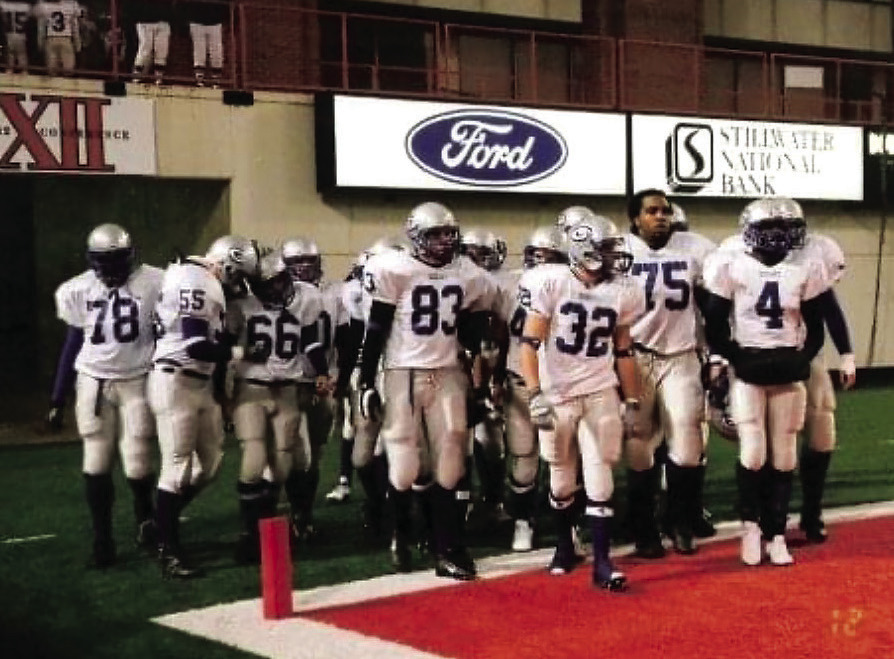
This is the first installment in a seven-part series on the 2002 Guthrie Blue Jays football team. Reporter Sam Hutchens spent the summer tracking down a multitude of former players, coaches — and even a former Oklahoma City mayor — to tell the team’s championship story. The Guthrie News Leader will run a part weekly to correspond with the ‘02 team’s 20th anniversary.
Rafe Watkins strolled through Guthrie High School in 2001, walking the halls of the place that could not entice a head football coach.
Watkins, 31, hadn’t applied for the Guthrie job. Heck, he’d even turned it down once when he was told the budget could not accommodate bringing his assistant coaches with him. He was comfortable coaching at Chisholm High School; and the lacking weight room and paint-deprived walls of Guthrie were far from attractive.
Less than two years later, Watkins would lift the Class 5A Gold Ball for Guthrie. But while walking through the Guthrie High School in 2001, he could only envision lifting paintbrushes and attempting to obtain some weight benches. The Guthrie football facilities were far from pristine.
Jelsma Stadium, or “The Rock” to locals, was a plus. The Blue Jays’ home, Jelsma Stadium is a 1939 Works Progress Administration project. It was built halfway underground, with a 30-foot sandstone wall facing Harrison Avenue that resembles a castle buttress. The Rock, though, had a history of housing teams at rock bottom.
And yet, as Watkins toured Guthrie and visited with the football team, the words of Rocky Carter, one of Watkins’ best friends who was the offensive coordinator at star-studded El Reno, stuck in his mind.
“He said, ‘(Guthrie) can’t find anybody to take the job,’” Watkins said. “And he said, ‘Rafe, I’m just telling you, they have as much talent as we do when they walk out on the field.”
When Guthrie, at Carter’s urging, offered Watkins the job for the second time, this time promising Watkins he could bring some of his Chisholm staff an hour south east to Guthrie with him, Watkins accepted. He became the 35th coach in Guthrie history in 2001.
“Guthrie’s facilities were not very good,” Watkins said. “When I coached at Northwestern we played Langston there at The Rock. I knew about The Rock and the history of it. It was a cool stadium, but you know, they just hadn’t had much success.”
The Blue Jays won a 1989 state title in baseball. Guthrie was known as a baseball school, and the football team’s performance had done nothing to dispel the notion. Despite playing its first football season in 1903 — four years before the Oklahoma Territory was issued statehood — Guthrie had not won 10 games in a season, much less a championship.
Watkins asked offensive coordinator Chuck Atchison to follow him to Guthrie. They inherited a team that had gone 25-68 in its previous nine seasons, so they made changes.
“They changed everything from the conditioning program to the weight room to the commitment of being here and doing things the right way,” lineman Chad Sanders said.
Some players did not embrace the changes, but most were receptive. The weight room quickly became mandatory.
“My off seasons in college weren’t as hard as my high school off seasons,” DeMarko Jones, Guthrie’s quarterback from 1998 — 2002, said. “They definitely came in and put their foot down...because we had athletes there. I’ll just say we were a little undisciplined.”
Atchison had heard no one really wanted the Guthrie job, but his skepticism was dissolved at the first team meeting.
“So when Rafe took the job, he asked me to come with him,” Atchison said. “And we went in and met the kids and talked to the kids. I mean, you look up and down the crowd, you’re like, ‘Oh, my God.’ There was no lack of talent.”
The kids on the offensive line were big and mean. Kyle Smith, a 6-foot-4, 270-pounder who went on to play at New Mexico, and David Washington, a 6-foot-4, 255-pound right tackle who became a starter at Oklahoma State, anchored the unit. Center Jon Farrow, who possessed only 5-foot-8 inches to spread out his 165 pounds —and consensus is the listing generous— was perhaps the feistiest of all. Detery Laws, who possessed a rarely-rivaled combination of size and strength, was a staple on the impressive defensive line. Linebacker Sam Murillo was a “man-child” and Guthrie had plenty of fast and agile skill position players.
And yet, perhaps the best football player at the school did not play.
Keenan Webb wasn’t allowed to.
“My parents wouldn’t let me (play football),” Webb said. “They were on this Jehovah’s Witness thing. It drove me crazy. I started becoming a rebel.”
Webb, a four-year basketball player at Guthrie, oozed with talent. At one point, a group of Guthrie football players Webb was close with joined up and petitioned Webb’s parents to let their son play. He was fast, elusive, possessed great hands and was strong. But Webb’s parents’ willpower was even stronger.
At the end of his sophomore year, when it seemed Webb may never play football, a slow class period changed Guthrie football’s fate.
It was at the end of weightlifting class, or maybe driver’s education. The details are fuzzy, but what Webb did with the boys in his class in the few minutes of free time between classes was hard to forget.
“We went outside to play football,” Webb said. “Back then we called it Sooner ball or something like that.”
Ric Meshew, Guthrie’s special teams coach, watched on, supervising the controlled chaos.
Webb lined up and ran. There weren’t crisp white sidelines or carefullycurated playcalls. Just backyard football. But Meshew knew what he saw would translate to Jelsma Stadium’s emerald grass. Webb went deep, drawing a double team. The makeshift quarterback launched the ball skyward, triggering Webb and his defenders to jump for the sky.
Webb leapt, corralling the ball with one hand while deftly orienting his body to crash down inside the imaginary sideline. Touchdown.
“Coach Meshew comes up to me and says, ‘Hey, you ain’t gonna do that no more and not play football. I don’t care. I’ll kick you out of this class,’” Webb said. “He told me I didn’t have a choice but to play football next year.”
Webb was elated and came out for football his junior year. He had no idea the teammates he joined would help rescue his life 20 years later.

Alt Text for Image
Alt Text for Image