

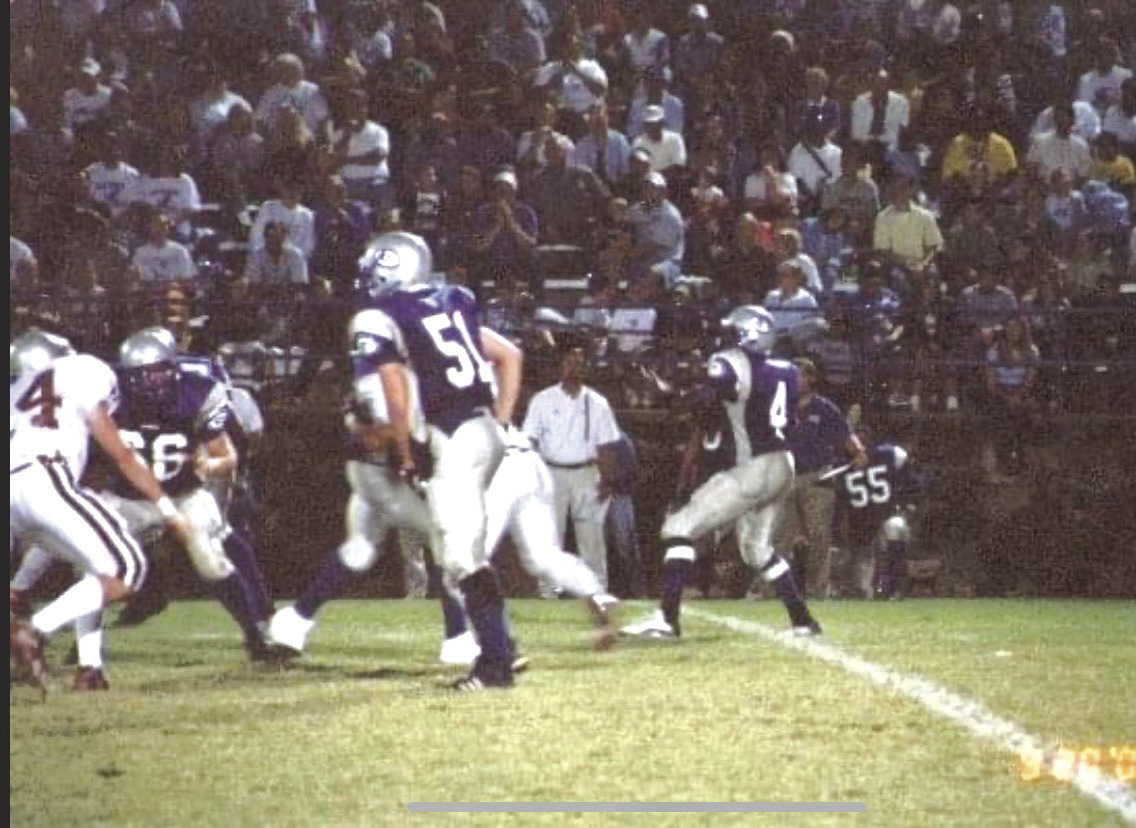
By Sam Hutchens
This is the third installment in a seven-part series on the 2002 Guthrie Blue Jays football team. Reporter Sam Hutchens spent the summer tracking down a multitude of former players, coaches — and even a former Oklahoma City mayor — to tell the team›s championship story. The Guthrie News Leader will run a part weekly to correspond with the ‘02 team’s 20th anniversary.
Guthrie won, but it did not assuage the coaching staff ’s concern.
In fact, the third game of the 2002 season amplified it.
“We were not getting worried a little bit,” special teams coach Ric Meshew said. “We were worried a lot.”
The Blue Jays had gotten off to a 1-1 start, losing at Shawnee in Week 1. The Wolves clipped Guthrie 25-15 in the opener, due in large part to the Blue Jays losing four fumbles and throwing an interception.
They had a “get-right” game in Week 2, beating Harrah 47-8. Receiver Keenan Webb had two touchdowns and De-Marko Jones, Guthrie’s star quarterback, ran for three and passed for one.
The Blue Jays thought they had a similar opportunity to light up the scoreboard in Week 3 against Weatherford. It was the home opener at Jelsma Stadium and, surely, the offense would be as potent as in the previous week.
Nope. “ We didn’t think (Weatherford) was very good,” Meshew said. “We had about 100 yards of offense that night.”
In retrospect, Meshew’s memory cast the night harshly. Guthrie actually had 156 yards.
The Blue Jays ran a Nebraska-I offense that had Jones, a dual-threat QB, taking snaps from under center. It was ineffective. Jones has just 55 passing yards, and it took 30 rushes for Guthrie to hit 101 yards.
The defense played well enough. Guthrie led 14-0 at the half and held on to win 14-7. The celebration was muted. The next morning, on Saturday, the coaches met in the football office to assess the lackluster performance and find a way to prevent it from happening again against a more talented opponent the next week.
Meshew, head coach Rafe Watkins and offensive coordinator Chuck Atchison had a blunt conversation.
“We had better come up with something different,” Meshew said. “Because if you think it was rough last night against Weatherford, wait ‘til Douglass gets a little piece of this Nebraska-I. They’re gonna shove it in a bad place.”
The solution was simple. “We had two athletes that were definitely difference makers,” Stone said. “DeMarko Jones and Keenan Webb.”
“They were definitely the two best athletes on the field,” Atchison said. “And they both were just gamers, they were players. I mean, they got the ball in their hands and you had a chance.”
While Jones’ skill was known by all in 2002, it took a baseball coach to originally see his potential.
Jones was always fast. His freshman year in high school, he started on the state 4x4 sprint relay team. Guthrie took third in that meet. But Jones didn’t start using his arm until eighth grade.
The switch happened on a water break at football practice. Jones, catching his breath from taking reps as a cornerback, started tossing a football around with some teammates. Even in eighth grade, Jones said he always had a strong arm. When he had his spiral, he could throw it about 50 yards.
At the watercooler that day, Jones’ spiral was tight. Casey Porter, the Guthrie baseball coach who assisted with football, had seen enough.
“Hey, we should try DeMarko at quarterback,” Jones remembers Porter saying.
Webb had gotten off to a strong start in 2002, but the offense was holding Jones back. He needed space.
“We said we’ve got to do something in order for people not to be able to stop DeMarko,” Watkins said.
The coaches left their meeting after making a decision. Jones would take snaps from the shotgun formation.
Guthrie practiced the new offense a little, but it was not ready for the game against No. 5 Douglass. Neither were the No. 8 Blue Jays, it seemed.
Douglass jumped out to a 21-point first-quarter lead. The Trojans had a pair of 2-yard touchdown rushes, at the start and end of the quarter, with an 85-yard Kevin Hudson touchdown run sandwiched between.
In the second quarter, Watkins decided to move to the offense he introduced in practice just five days prior.
“We really weren’t ready to start that offense yet,” Watkins said. “We’d only put it in on Monday. And we thought, ‘Well, crap, what do we have to lose? We’re down 21 to nothing. We’ve got to do something.’ And we started running some of the zone read and they had no idea what to do with it.”
Jones said he didn’t think switching offenses would work at first. But a few plays quickly made him a convert.
Jones ripped off a 42-yard touchdown rush. Webb caught a 13-yard pass from Jones, and receiver John Hudson hauled in a catch from 20 yards out with 47 seconds in the half to tie the game.
The coaching staff may have been Guthrie’s biggest strength. Watkins and his assistants thought on their feet. Atchison, who called offensive plays from the press box for a better view, was known for hurrying down from the highest point in a stadium during timeouts to meet with the offense.
Atchison would huddle, asking linemen about specific things, such as where they felt comfortable pulling, or what matchups they felt could be exploited. When Stone would hurry back up the stairs before the game resumed, he would already be concocting adjustments.
“He’d change it up, and the next thing you know the hole would be the size of Texas,” Jones said. “He made it easy.”
Jones bolted 47 yards for another rushing touchdown four minutes into the third quarter, and the new offense changed the game. Watkins said it felt like it happened in a flash.
“You look up, we’re up 28-21,” Watkins said.
The higher-ranked Trojans fought back, taking a late 33-31 lead. On Guthrie’s potential gamewinning drive, the Blue Jays receivers stepped up. Senior Jason Shoemaker caught an 11-yard strike and Webb got loose for 19 more yards. With 10 seconds remaining, Jones connected with senior receiver Cody Garrett on the sideline for 16 yards. It set up a game-winning 46-yard field goal attempt for Guthrie kicker Stephen Penrod.
In addition to quarterbacking, Jones also was the holder on kicks. It went back to Watkins’ belief that the best players should be on the field in key situations. It gave Jones a one-of-one view on the consequential play.
“Nothing went wrong with the kick,” Jones said. “They just overloaded the left side of their formation … I remember catching the ball, spinning it laces out, and as I was taking my right hand off the ball and I was picking my head up, I could see the guy in my peripheral standing right there.”
A Douglass player screamingaroundtheBlue Jays’ right side blocked the kick, providing Guthrie fans with a dismal end to the invigorating game. Douglass’ Antonio Walker returned the kick 71 yards with zeros on the clock, making the final score 41-31.
Watkins, though, was excited about the future.
“We knew we were onto something and we stuck with it,” he said. “And we never went back under center and people couldn’t figure it out.”
“That night, in my opinion, changed football history in Guthrie,” Meshew said.