

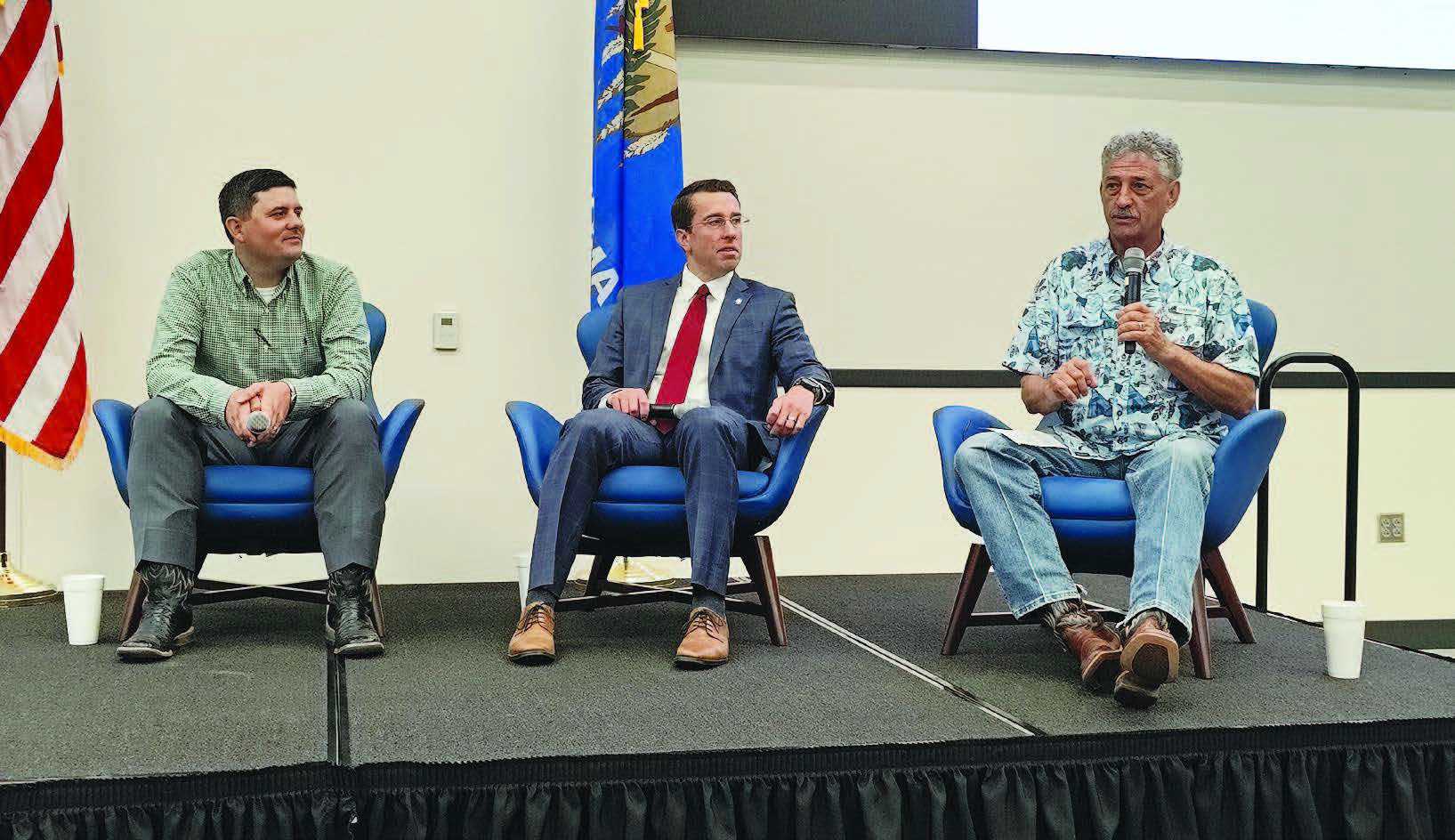
The Guthrie Chamber of Commerce hosted a legislative luncheon on June 25, 2024 at Meridian Technology Center South Campus, featuring Oklahoma House Reps Collin Duel, John Pfeiffer, and John Talley. Sponsored by Oklahoma Natural Gas and OG&E, the luncheon addressed crucial topics ranging from tax cuts and budget transparency to criminal justice reform and the burgeoning cannabis industry.
John Pfeiffer: Advocating for Transparency and Tax Cuts
Representative John Pfeiffer highlighted the state's financial health and transparency efforts. He proudly announced the largest tax cut in Oklahoma's history, including the removal of the state portion of the sales tax on groceries, which equates to a 4.5% reduction.
He also highlighted the state’s solid financial situation. “We have $5 million in savings,” he stated, adding "the state's revenue collections are up month-over-month, and we finished with a solid budget.” He emphasized the new transparent budget process adopted by the Senate, which allows the public to view all budget positions from various departments and chambers on the House's homepage. "It's not our money, it's everybody's money, so we need to be more transparent," he said.
Collin Duel: Empowering Citizens and Attracting Business
Representative Collin Duel echoed the commitment to budget transparency, noting the creation of an online budget portal. "Anyone can look at where the House's budget position, the Senate's, and the Governor's all stand," Duel explained.
Despite the failure to pass an income tax cut, Duel pointed to the state budget surplus and advocated for increased public involvement in budget decisions. "I think the people should get to choose where we spend our money, rather than the government choosing," he said.
Duel also discussed efforts to attract out-of-state businesses and emphasized criminal justice reform. He stressed efforts in felony reclassification and the importance of standardizing and making sentences consistent to reduce local discretion.
John Talley: Addressing Local Issues and Finding Good Solutions
Representative John Talley shared his personal journey and how he engages with local issues. "I had a problem in Coyle where they were calling me. We don't know it all, and we need to research what we're doing," Talley remarked. He also spoke of assistance from the other local representatives, thanking Pfeiffer and Duel for their support on agriculture and law enforcement issues.
Talley highlighted the economic development in Guthrie, noting new facilities, buildings, and ongoing construction. He also addressed common concerns related to the Oklahoma Department of Human Services (DHS) and emphasized the need for collaboration to resolve these issues.
Revenue Projections and Economic Shifts
The legislators discussed revenue projections and the state's evolving economic landscape. While the gross production tax on oil and gas has decreased for the first time since statehood, Oklahoma's diverse economy continues to thrive. Aerospace, tourism, manufacturing, and logistics are contributing to rising revenues despite the decline in oil and gas production.
"Unemployment is nearly zero, the economy is strong, and we're not as tied to oil and gas," Pfeiffer said, explaining the rationale behind recent tax cuts, given that the state’s tax code desperately needs updating for the new economic realities in the state. "We've made tough decisions to update the tax code, and now it works better for the current economy."
Cannabis Industry Challenges
The booming cannabis industry was another significant topic. Guthrie Mayor Steve Gentling asked about state control and improvements in the industry.
Talley, Duel, and Pfeiffer provided updates on recent measures. Talley mentioned increased authority given to the state Attorney General and sheriffs, while Duel spoke about higher licensing fees and expected improvements within two years.
Pfeiffer detailed the reorganization of the Oklahoma Medical Marijuana Authority (OMMA), which now operates as an independent agency. "We went from 9,800 grow licenses to 3,500, and we're hoping to cut that to around 2,500 within the next year," Pfeiffer said. He also discussed efforts to crack down on "straw owners" and plans for cleaning up abandoned grow properties, many of which are linked to organized crime and human trafficking.
Alt Text for Image